Showing posts with label Lancaster. Show all posts

Tuesday, September 24, 2019

Map of Greek America 1909


An article on Materialities that Bind under review (sadly twice as long as the mandated minimum, so lots to cut if accepted), an article comparing the spatial distribution of Greek immigrants in two Pennsylvania towns just accepted (written with the brilliant digital humanist David Pettegrew), an article on documenting site abandonment in press, and an article comparing Greek and Italian sacred spaces in the making (an ambitious edited project that I’m scared I’ll fall flat in). Greek American archaeology finding its way in print. I want to share a map. Pettegrew and I started building these spatial distribution maps of Greek immigrant communities. Our collaboration started by comparing the two towns we teach in, Harrisburg and Lancaster, the homes of our two respective liberal arts colleges. We asked the question, what does the Greek American story begin to look like without the two big elephants of Chicago and New York? So we decided to quantify our question. The map above shows the location and size of Greek communities based on the reporting of the Greek Business Directory. We learned that half of the Greek immigrant population lived in small communities of 50-200 people scattered throughout the country, making our little Harrisburg and Lancaster case-studies the norm rather than the exception. Our study then zooms into the spatial distribution of Greeks within the two cities. This involved plotting every Greek individual’s residence based on the four relevant U.S. Federal censuses (1900, 1910, 1920, 1930). We found radical differences in how the Greeks in two small cities only 50 miles apart occupied the urban landscape. Stay tuned for the article to appear in Pennsylvania History.

Tuesday, February 13, 2018

Digital City: First Year Seminar


Franklin & Marshall College's general education curriculum includes first year seminars known as Connections. I have proposed a new CNX seminar for Fall 2018 that explores further last semester's class Migration Architecture: Intro to Spatial Analysis (ART 175). Rather than introducing students to migration architecture from antiquity to the present, this new seminar takes Lancaster as a laboratory. The students will partner with a number of community organizations and create digital databases, 3D-models, maps and narratives on erased urban histories. We will partner with the Lancaster Historical Society and map the houses of prostitution as recorded by the citizens' Vice Commission in 1915. We will partner with the archaeological field-methods class and excavate a suburban house from the 1920s. We will partner with the Catastrophic Relief Alliance and assist a lower income neighborhood in fixing up destroyed houses. Finally, we will partner with Lancaster's African American Oral History Project and reconstruct the Seventh Ward, Lancaster's most racially and ethnically diverse wards that was demolished in the 1960s to build
public housing. This project will add to the comparative database that David Pettergrew has been building for Harrisburg and my students have been building for Philadelphia. David and I hope to write a comparative article for all southeastern Pennsylvania. We have presented our work in conferences and are busily teaching our students how to build databases with us. We are thankful to conversations with Amy Hillier at the University of Pennsylvania, whose 2012 work on mapping the Seventh Ward in Philadelphia has been ground-breaking.

Like the Seventh Ward in Philadelphia (which W. E. B. Du Bois studied door-to-door in the 1890s) the Seventh Ward in Lancaster was the African-American core of the city. Very little survives from it both physically and historically since the original community was pushed out by a public housing mono-culture of poverty. Last semester, Franklin and Marshall hosted a Common Hour lecture that summarized the galant efforts of Lancaster's African American Oral History Project. You can watch this important event here: "Singing the Lord's Song in a Strange Land: Africans in Lancaster Country," (Oct. 5, 2017), or read about it here. The discussion included Leroy Taft Hopkins, Jr. (Professor of History at Millersville University and President of the President of the African-American Historical Society of South Central Pennsylvania), Betty Hurdle (retired Housing and Community Advocate), Kevin Ressler (candidate for mayor), and Antonio Callari (Professor of Economics). 

In preparation for my seminar, I initiated the conversation with the Oral History Project. In consultation with Leroy Hopkins, I took a first look at the 1912 maps of the core of the Seventh Ward. My little sketch above confirmed multiple African American churches, a synagogue, and other lost establishments. I have had conversations with many different groups in Lancaster. The African American Oral History Project seems by far the most sophisticated, directed by the major historian of African-American life in the city. 

And here is my blurb for the seminar


The Digital City

Buildings, people, sewers, side-walks, trees, graveyards, schools, hospitals, traffic, and the flow of capital. Welcome to the greatest work of art in human history, a work saturated with codes, messages, ebbs, and flows and ideally suited for digital complexity. Our contemporary experience of cities is digitally mitigated by smart phones, devices, global positioning systems, satellites, street views, drones, and sharing economies. Digital literacy makes possible the simultaneous reading of time and space. The city is a material repository of human actions whose traces can be read like a physical book. We will immerse ourselves into Lancaster's urban materiality and write digital stories. We will study the production of space and consider how race, class, and ethnicity have transformed the American city. Each student will partner with a community organization ranging from oral history projects, refugee advocates, historical societies, and neighborhood associations. We will digitally reconstruct demolished neighborhoods, map topographies of vice, and even conduct an archaeological excavation.

Thursday, January 21, 2016

From Greek Village to the American City: Archaeology of Immigration

Franklin and Marshall College has a generous policy for faculty and student collaborative research. Every summer, I bring 1-3 students to do archaeological fieldwork with me in Greece, Philadelphia, Lancaster, or North Dakota. Building on such work with students, I propose the following plan of research for this summer. Here is my Hackman Faculty Grant application. See my report from two years ago, last time I applied for funds [here]

The image [R] is the inscription on a 1908 house in Leontio, Peloponnese, marking the American journey that its proprietor took to build the house.

From Greek Village to the American City
The Archaeology of Immigration

The Deserted Greek Village Project is an archaeological survey of late medieval and early modern villages whose abandonment began in 1893, after Greece's first major economic collapse. Between the 1890s and the 1920s, one in every four Greek men of working age migrated to the United States as a result of this economic crisis. These immigrants created new “Greek towns” in American cities, while also sustaining the villages back home through remittances. The study of material culture (objects, buildings, urbanism) of this phenomenon is by necessity a transnational project. This summer, we will turn our research to the study of both deserted Greek villages and the American Greek towns of the early 20th century. The fieldwork is divided into two parts: Two weeks of fieldwork in Greece, and four weeks of fieldwork in Pennsylvania. The team will include two F&M students, Elizabeth Wood (’17) who participated in last year’s field season and Cassandra Garison (’19). Wood will investigate domestic objects and Garison will investigate the houses of the project. Although working together, the two students will diverge in primary sources and methodology, a digital museum exhibition for Wood’s objects and a GIS database for Garison’s buildings. Both students were in my House Archaeology (ART 279) seminar last semester and have demonstrated both excellence and the desire to collaborate.

All three of us will travel to Greece and work collectively for two weeks. We will continue our documentation of the Lidoriki region with drone aerial survey, 3D modeling, GIS mapping, oral histories, and museum curation. Last summer we targeted the deserted village of Aigition and its objects and presented the results of this research at the Annual Meetings of the Archaeological Institute of America in San Francsicso. Our student Lizzy Wood ('17) presented a separate co-authored poster session at that meeting. This summer, we will submit an article for review in the Journal of Mediterranean Archaeology. While in Greece, we will also discuss contemporary migration by visiting refugee camps established for Syrian asylum seekers.

The Pennsylvania component of our research will take place at the Balch Institute of Ethnic Studies in the Historical Society of Pennsylvania, the Greek American Heritage Society of Philadelphia, and the Digital Harrisburg project at Messiah College. We will target three Greek towns in southeastern Pennsylvania: Harrisburg, Lancaster, and Philadelphia. With the assistance of Digital Harrisburg (that has already mapped its Greek town), we will map the Greek towns of Lancaster and Philadelphia by linking census data from 1900-1940 to individual properties. While identifying the buildings into which Greek migrated, we will also catalog contemporary objects and records from the Philadelphia diaspora (housed at the Greek American Heritage Society museum and the Balch Institute of Ethnic Studies). The questions we will ask are how did rural Greeks from mountainous villages transition into row houses of eastern Pennsylvania? What kind of material culture did they bring from Greece, and what kind of material culture did they send to Greece? Most ethnic groups migrating to the United States did not leave extensive textual sources. The first generation of immigrants, even if literate, spent its resources as laborers rather than intellectuals. Material culture, thus, offers a unique window into a transnational experience.

I initiated the Deserted Greek Village Project in 2014 with the support of a Hackman Research Fellowship and the assistance of students Joel Naiman ('15) Hackman Fellow and Joanna Radov ('16) Summer Research Fellow. Elizabeth Wood joined the research as a Summer Research Fellow in 2016. Based on those experiences, Naiman is currently pursuing a Master’s in Historic Preservation at the University of Pennsylvania, and Radov is exploring graduate studies and scholarships post-graduation. Wood’s co-authored poster at the Archaeological Institute of America was the first time an F&M presents research on this national forum. This semester, Wood is taking an Independent Study, where she will design an online exhibition for the 136 objects that she recorded in the Lidoriki Folklore Museum last summer. Garison has already done demographic mapping of Lancaster census data for my House Archaeology seminar and will be learning GIS this semester.

Bibliography:

Biermann, Shelby, Todd Brenningmeyer, Sara Loynd, Miltiadis Katsaros, Kostis Kourelis, Austin Nash, Nicole Thompson, Elizabeth Wood. 2016. “Artists at Aigition: Documentation, Design, and the Investigation of Rural Greek Villages,” Poster Session, 117th Annual Meeting of the Archaeological Institute of America, San Francisco, January 7, 2016.

Brenningmeyer, Todd, Kostis Kourelis, and Miltiadis Katsaros. 2013. “The Lidoriki Project: A Historical Topography,” Sixth Annual Congress, Science and Technology for the Safeguard of Cultural Heritage in the Mediterranean Basin, Athens, Greece, Oct. 25, 2013.

Brenningmeyer, Todd, Kostis Kourelis, and Miltiadis Katsaros. 2015. “The Lidoriki Project - Low Altitude Aerial Photography, GIS, and Traditional Survey in Rural Greece,” Computer Applications and Quantitative Methods in Archaeology (CAA) Annual Conference, Sienna, Italy, Mar. 30, 2015.

Brenningmeyer, Todd, Kostis Kourelis, and Miltiadis Katsaros. 2016. “Drones and Stones: Mapping Deserted Villages in Lidoriki, Greece,” 117th Annual Meeting of the Archaeological Institute of America, San Francisco, January 8, 2016.

Kourelis, Kostis. 2008. “The Archaeology of Xenitia: Greek-American Material Culture, 1873-1924,” in Archaeology and History in Roman, Medieval and Post-Medieval Greece: Studies on Method and Meaning in Honor of Timothy E. Gregory, ed. Linda J. Hall, William R. Caraher, and R. Scott Moore (Aldershot: Ashgate), pp. 411-453.

Kourelis, Kostis. 2008. “From Greek Revival to Greek America: Archaeology and Transformation in Saint George Orthodox Cathedral of Philadelphia,” New Griffon 10, pp. 28-36.

Kourelis, Kostis and William R. Caraher eds. 2010. The Abandoned Countryside: (Re)Settlement in the Archaeological Narrative of Post-Classical Greece, special issue of The International Journal of Historical Archaeology 14:2 (June 2010)

Kourelis, Kostis and Vasileios Marinis. 2012. “The Immigrant Liturgy: Greek Orthodox Worship and Architecture in America,” in Liturgy in Migration: Cultural Contexts from the Upper Room to Cyberspace, ed. Teresa Berger, pp. 155-75, (Collegeville, Minn.: The Liturgical Press), pp. 155-175.

Monday, November 09, 2015

Leon Von Ossko: Part 2

Who would have thought that Lancaster, Pa. is a haven for Orientalist drawings? Back in February, I had posted about the Hungarian baron Leon Von Ossko, who fell in love with a prominent Lancasterian in Florence and moved to Pennsylvania. Franklin and Marshall College's Phillips Museum has one of his drawings in its possession, through the college's Breneman/Peart/Brockius family donations.

The beauty of blogging is that it allows you to be a temporary expert on a topic that little has been written about. While cataloging her art and thinking about framing some pieces, Bettina Heffner of Lancaster came across a drawing that a friend had given to her family in the 1970s. Since the artist's signature was hard to decipher, Bettina asked her friend Joanne Stephen, a calligrapher, to help her out. Joanne made out most of the letters of Von Ossko and simply googled the name to get more information, and lo and behold my posting "Leon Von Ossko: Lancaster's Orientalist" came up. Bettina then contacted me and we started communicating over email.

Today, we finally had a chance to meet. Bettina came to the Phillips Museum with Joanne to see the Von Ossko in our collection and brought her Von Ossko to show us (shown above). This chance meeting turned into a fabulous art-historical seminar, joined in by Lindsay Marino (the museum's collections manager). The Heffner Von Ossko is vividly similar to the Phillips Museum Von Ossko. Both depict a street scene in Cairo although illustrating a different mosque. The style is similar (pencil drawing and water color) and clearly belongs to the same group. The ingenious Ben Anderson, professor of art history at Cornell University, has identified the monument as the mosque of Amir Aytmish al-Bajasi. When I asked Ben, how he identifies these Mamluk mosques so well, he modestly said "every dome is different."

Whereas only a few months ago, we had an odd Orientalist work at our museum, we now how a family. Two drawings do not a show make. Nevertheless, they give promise of a line of Orientalist inquiry to be further developed in Lancaster studies.

Thank you Bettina and Joanne for sharing your work. 

Tuesday, May 26, 2015

Pine Door 1770

Door
1770-1800
Pine, painted decoration, iron
Made in Pennsylvania
Titus C. Creesy Collection
1953-125-18
Philadelphia Museum of Art

Summer is here, tenure has been granted, I rush to finish a sleuth of over-due articles, while also getting ready for another season of The Deserted Greek Village Project. After a hiatus, I feel compelled to return to blogging.

I have been thinking a lot about vernacular culture across Pennsylvania and Greece. This year has been the year of Pennsylvania fraktur with three exhibitions, Drawn with the Spirit at the Philadelphia Museum of Art, A Colorful Folk at Winterthur, and Framing Fraktur at the Philadelphia Free Library.

What has also become clear to me is that Franklin and Marshall College had been a pioneer in the study of Pennsylvania fork arts, a specialty that we have mostly left to the wayside. Before moving on to the University of Pennsylvania and establishing the discipline of Folklore and Folklife, Yoder was teaching at FandM. Generally speaking, the study of American folk arts seems to have become co-opted by heritage. Pennsylvania German art has been co-opted by the heritage industry most aggressively. Walking through the fraktur exhibition, it becomes clear an elderly white Christian group is the target audience. In engaging younger contemporary artists, the Free Library has tried to break that mold. In similar ways, Greek folk arts have lost the critical edge that they had in the 1960s.

The most important story to be (re)told about the arts of the Pennsylvania Germans is that it's radically different from the art of the English Protestants. What the Germans brought to Pennsylvania is the rich visual culture of the Baroque. Their Quaker hosts (William Penn, etc.) had a fundamental mistrust of art and architecture. Even if some of the German groups were radically anti-art, a great majority of them brought continental visual traditions to the U.S. German Baroque is absolutely wild and has nothing to do with the reserved nature of its British equivalent.

I strongly recommend Don Yoder's 2001 “The European Background of Pennsylvania’s Fraktur Art,” and “The Fraktur Texts and Pennsylvania-German Spirituality,” in Bucks County Fraktur (Pennsylvania German Society 23) [I can send you PDFs]

The door above is in the permanent collection of the PMA. I sketched it because I wanted to figure out the parts and sequence of its construction. Note that the two vertical boards are primary with the three horizontal boards as secondary and the painted panels are tertiary. The panels are painted and decorated by curved shaped that stand out in such a way as to negate the architectonic logic of the door. The painted panels, in other words, float into space. They are served by the door as frames. Within each panel, we have the figure of the heart. Iconographic scholars have beaten the symbolism of the hear to death, as a reference to Christianity. What I see instead, is a smart game of transformations. What might look like a heart at the first upper panels is flipped in the second upper panel to create a dual composition. The heart stops being a "heart" and it becomes a formal game that can lead to imaginative connotations. The upside-down heart, for instance, begins to look like a fruit. It touches its parent shape at the tip adding a sense of visual tension and fragility. At the lower panel, the shapes melt into a third shape. I don't know about you, but to me the final derivations is suggestive of the human body. I see a torso and a posterior with the breast or shoulder shapes above. Anatomically suggestive of the human body, I interpret this as a sexual transformation.

The architectural challenge of any door is to counteract the weight of its material, greater at the bottom than the top. The two iron hinges act quite differently, the top hinge is in tension, the bottom hinge is in compression.  The shapes at the lowest panel, it seems to me, hint on the horizontal striation of any door. The concave and convex shapes address gravity towards the earth and the aspiration of ascent above.

One group of people that loved Pennsylvania folk arts were the Modernists. The 1770 door makes it clear why someone like Charles Sheeler used Ephrata Cloisters as a source of inspiration in the 1930s. Looking at folk art with fresh eyes, even through the spectacles of modernist formalism, makes them provocative once again.

Friday, February 20, 2015

Leon von Ossko: Lancaster's Orientalist

View of Funerary Complex of Qaytbay, Northern Cemetery, Cairo

By Leon von Ossko (1859-1906)
1901

The Phillips Museum of Art at Franklin and Marshall College is a treasure-trove of artifacts that we are in the process of cataloging. 

In December 2012, our then collections manager Maureen Lane discovered a drawing in the vaults with obvious orientalist subject matter. As I was teaching Islamic Art, she naturally asked my advice. This year, I teach Islamic Art again, our collections manager Lindsay Marino is installing the work for public view and has asked me to include some scholarly context. So here is the story of this fabulous drawing.

Leon von Ossko (1859-1906) was a Hungarian nobleman. The baronial title was bestowed on the von Osskos, interestingly enough, for fighting the Ottomans in the Ottoman-Habsburg Wars. Although Hungarian, Leon was raised in Germany and attended university at Heidelberg. After his graduation, he traveled through the United States for two years with a cadre of European aristocrats, exploring the Wild West. Between Denver and the Pacific Ocean the group encountered conflicts with native American tribes and von Ossko was wounded. During that American journey, von Ossko met Ella Louisa Breneman, the daughter of Christian Herr Breneman, a prominent citizen of Lancaster county. Their courtship lasted for two years across two continents. They were married in Florence in 1884. 

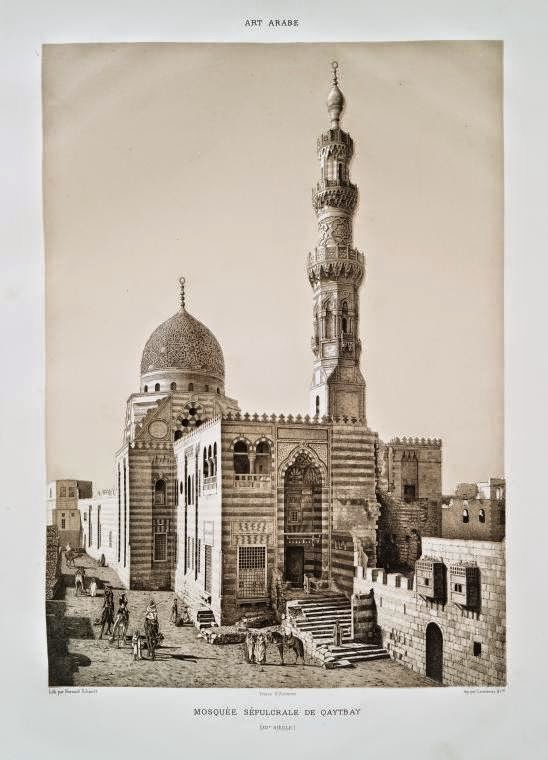
Von Ossko became an accomplished artist studying in Florence and at the Academy Julian in Paris. After his marriage to Ella, he moved to Lancaster. Little is known of his artistic production. In a biographical note (Breneman 1912), we read that his oils and water colors were exhibited widely across New York, Philadelphia, Washington, Baltimore and Cincinnati. The drawing found at the Phillips Museum has an orientalist subject, the Mamluk funerary complex of Qaytay, in the Northern Cemetery in Cairo (15th century). I thank Emily Neumeier and Christy Gruber for making the precise identification. I also thank Benjamin Anderson for identifying a particular fascination of this monument by German viewers. In his blog post "A Piece of the Orient on the Elbe,” Stambouline (July 17, 2015), Anderson offers a similar view published in  Émile Prisse d’Avennes, L’art arabe (1869-77), shown left.

It is so intriguing to think of Lancaster, Pennsylvania, as an epicenter of German Romantic Orientalism through some newcomers, like von Ossko. The drawing is dated 1901 at the bottom right. As early as the 17th century, Germanic colonists in Lancaster County had direct exposure to the Islamic world through the Ottoman Empire, which reached Vienna. A current exhibition on Pennsylvania German Fraktur at the Philadelphia Museum of Art, for example, includes a drawing depicting Ottomans drawn in Pennsylvania. Some of the iconographic motifs in Pennsylvania German art (tulips, etc.) have Ottoman origins. But this larger question of German orientalism transplanted in Pennsylvania is a fascinating unstudied topic.

It is interesting to note that Lancaster's current City Hall (left) makes references to Islamic architecture (the Alhambra). Originally designed as a Post Office by Philadelphia architect James Windrim (1891), Lancaster's City Hall would have gone up just ten years before Von Ossko had done his drawing [On Lancaster City Hall, see here, p. 8]

Unfortunately, there is very little historical coverage on Lancaster's orientalist painter. We do not even know how Franklin & Marshall College ended up with this drawing. The Brenemans were related to Caroline Peart, a little known but important American Impressionist. Our college has received Peart's archive and von Ossko's drawing might have come as part of that package. On the subject of Caroline Peart, make sure to see her painting currently hanging at the Nissley Gallery of the Museum and look forward to a massive retrospective curated by our Kate Snider

In trying to put together the urban topography of Lancaster and its prominent citizens, I did some research on the house where this drawing might have originally hung, the house of Leon von Ossko and his wife Ella Louisa Breneman. It is a beautiful Greek Revival townhouse built in 1852, located at 47 North Lime Street (SE corner of Lime and Orange).

The house's most outstanding feature is its marble porch with classically correct decoration that stands out among the Palladian wooden porches common to Lancaster. The house has its original iron work.

Von Ossko died in 1906 in Saint Augustine, Florida, where he had moved for health reasons. He was survived by two sisters that lived in Florence. One was married to a Count. I have not done any research on Anna Louisa Breneman and the Breneman family. The house seems to have been sold in 1937. In 1987, Tabor Community Services bought the house and converted it into Beth Shalom, or "House of Piece," an interim housing facility for women in need. 

BIBLIOGRAPHY

Marble neoclassical porch with Tuscan capitals and acanthus frieze

Neoclassical iron work on exterior fence

Friday, November 21, 2014

Mystical K

William Penn and Benjamin Franklin have dominated Pennsylvania's historical airwaves. Their no-nonsense Protestant ethic served well the ideology of the nation as it developed into a capitalist empire. It is particularly interesting how the majority of Philadelphia Quakers became Episcopalians in the 19th century, suggesting that Quaker spirituality became increasingly incompatible with the industrial state and its needs for material representations. The Quakers mistrusted the visual arts and discouraged their practice.

The Quaker monopoly over how we construct Pennsylvania's identity has eclipsed a parallel tradition that, in contrast, embraced the visual arts as a vehicle for revelation. It grew out of radical Pietism in Germany, which established itself in Lancaster County in the 1730s. Its best known experimental community was Ephrata Cloisters. Susanna Hübner was one of the mystics residing in the Ephrata convent. Like Benjamin Franklin, she produced a book of ABCs, a collection of spiritual poetry. Hübner's letters become visual exercises of meditation as the reader is incapable of ever capturing a calligraphic whole. I have been thinking about Hübner's calligraphy, as I prepare my course on Islamic art, noting a similar spiritual strategy. Above, I have copied the letter K and imagined how Susanna would write my name, in delayed and apophatic silence.

My own college is integrally connected to Ephrata Cloister and German mysticism through Marshall College. Although its founders chose to honor John Marshall, the supreme court justice has very little to do with the college. Similarly, Franklin College honors Benjamin Franklin, who sent a financial donation for its establishment. Franklin's interests were in making sure that the Germans did not secede. The establishment of an Anglo college in the heart of a German county was a measure of realpolitik. Benjamin Franklin and John Marshall take center stage in all of my college's public relations. Lately, I have become a little annoying in trying to highlight the other tradition that has deeper organic roots to our college. I also feel that without an understanding of 18th-century German mysticism within a Baroque vocabulary, Pennsylvania arts become totally incomprehensible. Like the persona of Franklin & Marshall, the mystical art of the German tradition becomes fodder for a shallow consumption of primitivistic Christian tourism.

Wednesday, July 16, 2014

Jesse Vital's Lancaster Mural


The American urban landscape contains hand-painted images that are often drawn by unknown artists and illustrators. Lancaster is such a place. Benjamin Leech and I have noted the need to somehow document the city's vernacular heritage. One of my favorite Lancaster murals is at White's Auto Sales and Services located on 4 East McGovern Avenue. So, one day, I decided to walk into the automotive repair store and talk to the owner, who gave me the name of the artist who did the mural, Jesse Vital. The next step was astounding. Through some initial research, I learned that Jesse Vital is currently a successful illustrator for Hollywood. The mural was one of his earliest projects. He painted the mural in return for some auto work on a van he had just bought, which would become his ticket out to California.

The story was amazing enough that I had to talk to Jesse, who generously granted me a telephone interview on May 24, 2014. What follows is the transcription of that conversation. 

KK I wanted to get a bit of the history of the mural and the circumstances about your life in Lancaster. I’ve seen you are a pretty accomplished illustrator in the West Coast, and it’s exciting that you’ve had some time in our neck of the woods.

JV I’ll try to hit the major points. I was born in Lancaster and my dad, my family still lives there. I had moved around a little bit with my mom when I was a kid and wound up in art school in North Carolina, in the North Carolina School of the Arts, and then in Baltimore at Maryland Institute College of Art, I went there for a couple of years, too. At one point I just wound up moving to Lancaster, I didn’t really know what to do and that was around Y2K. I moved back to town, and I had a little bit of experience waiting tables, so I started to do that for a while. I was still pretty young, I’d say probably 23-24, and I had quite a fine art background. I did a lot of figurative work and painting, but it was more classical style than abstract.

KK I can see from your website that you’re pretty amazing realistic classical representation.

JV The website is reflective of the kind of commercial work that’s really popular out here in Hollywood, which is a very fast illustration, a lot of sketching. It’s very heavily figuratively based, so it suits me. It’s fast, it’s all done on the computer, it’s done with a screen tablet, so I draw right into the computer. It allows me to manipulate textures and brushes really fast. That style was something that was kind of new. At the when I was in Lancaster, I was doing a lot of oil painting and drawing, and I hadn’t done any illustration per se. When I was working at one of the restaurants, Symposium Restaurant actually, which is out on Columbia Avenue, I want to say. They needed a mural. They came to me because they knew I was an artist, and where like “will you do a mural in our new addition to the building?” So I took it on, and it was very, you know, it was kind of a big deal for me, but looking back it was like 1,000 dollars. You know, it was just fortuitous. Who else was going to do it?

KK Do you know if it’s still up?

JV I think it is. I wouldn’t testify to the quality because I really didn’t know what I was doing. I never had done this kind of thing before. So I was trying to scale up the painting I was doing to a mural. I really didn’t have any training on how to do murals or a good business model. I had no apprenticeship per se. So I just kind of jumped in because that’s the kind of person I am. So I did that one. I did a few others. From that I got quite known for doing murals because there was a small article in the paper, in the Life Style Section. It’s in the Lancaster Newspaper, I want to say it’s in the Sunday edition. I think I have the article if you need me to, I can scan it and send it off to you. I did a few projects. And I would always be working as a waiter. I also worked at Lancaster Galleries then for a little bit in the frame shop, and I was doing frame restoration with them. At the same time, I was also really into music, so I was playing a lot of gigs as a musician. And through my gigs as a musician, I got hooked up with this guy that was opening up a garage. He was like, “hey, I need somebody to help me create a logo and maybe a sign for my garage.” I guess, instead of him going to just a regular sign shop, he wanted something special, and I guess somebody told him that I could something a little special. I believe my friend Brett Stabley who is my dad’s friend hooked us up because he was a little bit older than me.

KK Is it the guy that’s there now because he is the one that gave me your name when I inquired?

JV This guy was named White, I can’t remember his first name. It was White’s, and it was his own personal garage. So, I said to him, “look,” this is the funny part of the story, I said “I just bought a Volkswagen bus, a 1976 Volkswagen Camper bus and it needed a lot of work.” I had actually bought a second Volkswagen bus that was in the process of being restored, so it had all the windows out, it was really just for parts. So I had these two buses, and I said, “I want to take the engine out of one and put it in the other, but I do not know how to do that. So if you guys can do that for me, I’ll do all your signage and your business cards and all your logo stuff.” And they were like, “OK.” So it was really a handshake deal. No official contract. It was just a trade, like a real down and dirty. I had the bus towed into his shop. I came up with some sketches. I said I want to paint a mural on the side of the building. Because he wanted to compete, there were a lot of car places in that area and he wanted his to stand out. And I said, you know, we should do something where we put the logo on the side of the building. And he kind of was like said, “OK, do whatever you want to do. Just do it.” There was no creative direction from him. He liked the sketches of the little logo I designed, which I had drawn by hand but scanned in the computer and finished off in the computer. So it had a real crisp graphic look to it. And then, what I did for the mural is, I printed it out and then I had a projector. I believe I borrowed a projector, and we projected it on to the wall and aligned it. Because I was so worried, I hadn’t done an outdoor mural, so I used Rust-Oleum paint, like in a can. I just bought the appropriate colors. Some of them I had to mix to get the colors right and I believe it held up pretty well because I think it’s still there.

KK Yeah. I don’t know how bright the original was but it looks very very clear.

JV I think it’s just. If it’s dulled anything, I think it’s just the white has maybe dulled just from dirt. I think that Rust-Oleum paint is pretty indestructible. I was very careful about it because it was more of a transfer. When I painted it on it was very precise. And then, he, I don’t know if it’s still there, but he had some signs out front, on the front side, above the garage doors which I painted. His logo that I designed across “White’s Automotive” and the phone number.

KK And the wrench, right?

JV Yeah, it has the wrench. Well the idea was that the wrench was just the simple logo and the other guy was the more complex logo. And again, I should emphasize, I had no idea what I was doing. This wasn’t something, you know, it wasn’t like you hired an advertising company and I was subcontracted. I was just trying to do what I thought was appropriate if I owned the garage. You know, this is what I would do. It was very simple. It was a learning experience because I had to learn how to use the computer to make art. It was one of the first times I had done that. Also, I think, around the same time, I did a mural on the side of the Alley Kat, which is I believe on Prince Street, or Duke Street, I can’t remember, it’s down there. It’s not far, in fact, I think I met the White guy from playing in the Alley Kat. I had painted some little cats on the doors in the Alley Kat, where there are these little cartoon cats are peeing. So, like the little cartoon cat man is peeing in the urinal and there is a little cartoon cat girl, she’s like a Siamese cat, and she’s sitting on the toilet. And they are fun and innocent, cute, little paintings because again, I knew the guys, and they were “well, what would you do?” And then they had that side of the wall and they wanted to just do something bigger and I painted the logo. But that logo on the Alley Kat I did not design. So the White’s one was much closer to my heart, I was personally invested in that one. And that’s one of the reasons why I was so anxious to actually have this interview because it was something that I really enjoyed doing.

KK …. Your mural is my favorite and I wanted to start with that one.

JV Yeah, I do know there is a woman who’s really known for it [Karen Hunt]. I can give you a little bit of background from what I knew from working because the art scene in Lancaster, if you were a struggling artist, was actually quite small, people that were handing out jobs to do, for example murals or a portrait. And I did a lot of informal portraits for people. For some reason I got known for painting a lot of people that had recently died. So, I did about half a dozen paintings from these old photographs of a dead grandmother or grandfather. But I knew a bunch of people that were struggling artists. One of the things that Lancaster has that not too many people know about is that there is a big sound stage company called Clair Brothers. And Clair Brothers, I believe are in the county, near the airport, I’ve never been there. But right next door is a separate company, kind of a sister company, a little bit smaller, it’s its own company, but I don’t remember the name of it, but they do stages, they do backdrops for the stages. [see Atomic Design] So Clair Brothers builds the stage, and they’ll build stages for Bruce Springsteen and Rolling Stone because there is a lot of space up there, it’s wide open, they just make these mobile stages, the ones that they brake down and put in like ten tractor trailer trucks. Then the sister company will make the backdrops and they will paint the logo of the band or they’ll design something specific for the set piece; they work with the art director. And that company has, … they’re doing these large large paintings, I’d say, you know, 30 feet across some of them, no canvas, that they roll up. They also work a lot with MTV. And I knew a guy that used to work there, and he worked at the Lancaster Gallery with me. And he knew a woman that also used to work there. She did a lot of the murals around town because she learned how to do murals by painting these backdrops. And she did the one that’s, I want to say, I’m really bad with my street names. She did one around town that’s on the side of the building, it’s on basically, if you were at Franklin and Marshall and kind of drove down towards closer to town, to Queen Street, you might run by it. [West End, Karen Hunt]. When I was living there, there was a tiny little bird store. It’s on the side of a block of row houses and it’s a scene of row houses. And it’s one that the mayor, I think commissioned her, and the neighborhood got some funding together. I don’t remember her name, but if you were to contact Lancaster Galleries they definitely would now, because they are much more closer related to the art scene in Lancaster. That would actually be a good place to do some research, too, because a lot of artists go through there…. There is not a whole lot of money to be had in Lancaster, if you are an artist. You can pickup a mural, you can pickup certain things, it’s kind of like, a portrait here or there. I would make a little bit of money, but I don’t think I ever, you know, made enough to definitely do it fulltime. Now being a commercial artist in Hollywood, I moved out here in 2006, and I was lucky enough to break into the scene. There is a lot more availability for illustrators and artists working in entertainment, but what I know now about how things are done, if I were to go back to Lancaster, you have to sell to tourists. You can’t just do things that people are asking you to do, you basically have to be a businessman, if you want to be successful. That’s my opinion.

KK If I may ask, how did you, did you already have a job and then move to the West Coast?

JV Oh no. It was my dream to move out here. So I spent from 2000 to 2006 in Lancaster and the whole time I would tell everybody, “well, I’m moving to California next year.”

KK You had the bus, right?

JV I bought the bus to move to California, that was the whole point. But then as it turns out, I ended up moving right to the middle of Hollywood. And the more I researched it and talked to people that had had some history and some experience with California, they said, “well, if you are an artist, you have to move to Hollywood.” That was the thing I heard over and over again. I didn’t necessarily want to move to Hollywood, it’s not the nicest part of California, it’s not as beautiful as San Diego, or some of the other beach towns, or San Francisco, but it was actually a very good decision because there is a lot of opportunity for artists in this town in all kinds of respects. But there is so many jobs working in movies, special effects, storyboarding, commercials, a lot of storyboarding jobs. In fact, that’s what I was doing last night. All the stuff you se on TV, every commercial you see on TV, every action scene in every TV show. I knew artists that were storyboarding on Jonas Brothers. They would go to the Disney lot every day and just draw with the director, for the Jonas Brothers TV show, which is kind of like a very low ranked TV show. They still need storyboards, they still need to show everybody what they’re going to be shooting for the day. And then I worked mostly on advertising, so I do a lot of the movie poster stuff, which suits me really well, and it’s kid of like a dream come true because for a while I was very much interested in movie posters as a kid. The West Coast is an image place so drawing, art in general, visual things really suits this place. New York, I have a friend there that does storyboards, and he can find work working for advertising companies and stuff, but it is even harder. It’s harder than here, where I get sometimes four calls a day. I’ve been very busy, very busy….

KK Would you come to F&M and talk to our studio art students about your experiences?

JV Oh totally. I really want people to know that if you really strive and this is really your passion, you can preserver. There is a lot of opportunity. It’s different kind of opportunity. Like I said, if I were to be in Lancaster and that’s where I’d have to make it, I would be much more along the lines of Tom Hermansader, are you familiar with him? He would paint local scenes, like the square, or the opera house, and then he would sell them at the mall, you know. You basically create a commodity, a product, and then everybody in town would end up buying one for very cheap, you know, 20, 30, 40 dollars, just a print, a framed print. I worked with him just a little bit, but he did very well. He was very successful as an artist and he owns two Victorian mansions in Columbia that are just gorgeous, restored, beautiful homes. I mean, he owns two of them, that’s not bad for an artist.

KK Is he like a local Thomas Kinkade?

JV Yeah, basically a local Thomas Kinkade, Yeah, exactly, almost the same kind of feeling, too. You know, it’s art that makes you feel good about the place that you live. And that’s certainly an opportunity that is available to anybody, but a lot of people. I always like to stress the point that creative people can sometimes be incredibly uncreative when it comes to making money. [laugh] You have to basically take the creativity, the creative spirit, and apply it to every aspect of your life because otherwise you’re dead in the water. As soon as you get boxed in with your thinking, “oh, well, if I don’t get another mural, you know, then I’m gonna go broke; let’s give up being an artist.” That’s not how it works. Sometimes you have to take that portrait job or learn calligraphy, or do whatever the market wants or needs and right now, even in my career, which is quite lucrative and very successful at the moment, I constantly have to stay ahead of the game, otherwise I’ll just get bored. So even when you are successful, I fell like you still have to be creative. Constantly. I don’t even like to do the same thing for too long. As soon as it gets easy for me, I get kind of bored.

KK Great. This has been very interesting to hear your trajectory and make the connection with the mural that I see everyday and you probably haven’t seen in years.

JV You know, it’s funny, every time we go back, I try to drive by it, I love it. You picked the one that I am really truly, I feel like it’s my baby. I’m glad to know that someone is interested in Lancaster’s artistic heritage. I do suggest that you go by and talk to the people at Lancaster Gallery. They are very much in, they carry the flame, so to speak, and they are very community oriented, and they know everybody. If you needed a mural, they would tell you ten artists that you can call, you know? They are that type of company.

KK What do you think makes Lancaster so unique in its art scene, is it because of PCAD and Millersville? Is it because it’s close to Baltimore, Philadelphia, and New York?

JV I knew a lot of the guys. My mother was divorces when I was very young and one of her friends was an artist. I believe he went to Millersville. He was very very good and I knew that he was, ever since I was a little kid. He would bring me comic books that his friend illustrated, people like Timothy Truman, who lives in Lancaster. Now all these guys, all the best artists in town, the really good draftsmen, the really classically oriented guys, guys like the one I’m speaking of, Jeff Guide, they all eventually coalesced around PCAD and became teachers there. I believe in the 80s, from what I’ve heard, the art scene in the 80s in Lancaster was very good. As far as a small town goes, people had a lot of money, the rich people were buying a lot of original art, it was a sort of Renaissance in Lancaster. And then, PCAD kept it going, when that started up, and kept all these guys with food on their tables. And then lately, it’s had another rebirth because of the whole Queen Street scene. So, I think form what I understand, as far as being an artist in Lancaster, the best times were in the 80s because you could have an art show and you would sell most of your paintings. Now you’re lucky to sell a few. But some of the best artists, some of the really popular ones that have collectible stuff, and have a little fan base, they’ll still do very well. In Lancaster Galleries they would have art shows once a month, once every six weeks and about two or three times a year they would have somebody in that would just sell out. All their work was very lucrative and very collectible. But most of the time, they were just doing it because they were supporting the artist. You know, they would sell enough to break even to make up for the advertising. But Lancaster, I think, I can’t speak of it now because I left in 2006, but my feeling is that in general people like art, they want it, they seem to now maybe need permission, you know, whereas back in the 80s it was much more of a competitive thing. Oh, you know, how successful your office is and how nice your art is on the walls. Everybody kind of knew and it was like a game. I remember going into my dentist’s office and it had these beautiful paintings by David Brumbach, I believe is his name, beautiful watercolors, they were done in the 80s. It was just amazing, large, city scenes, rainy wet Lancaster streets, but beautifully painted and they were all originals. And I found out later that that was his dentist [laugh]. They were just traded. The dentist would spend a lot framing them, making them look really beautiful and it would create an atmosphere of affluence, you know. And I didn’t see that kind of work in the 2000s, but I’m sure it’s coming back, whereas you are creating that vibe of affluence by having really nice art. I would be happy to talk to the students, and make sure that they know that there are possibilities and opportunities out there. Like I said, you have to be creative and you have to be really really stubborn, and incredibly determined. It’s definitely there. It may not be there in the way that they imagined in their heads, because I know I had imagined this fantasy about being this famous artist when I was a kid. Believe me, I don’t know anybody that has that fantasy. The ones that are the most successful are the ones that just work, 24-7. I can tell you a few friends that haven’t had a vacation in several years, but they are very successful artists.

KK Good, I think I got enough to get me going. I will definitely keep in touch with you.

Tuesday, February 18, 2014

Slow Archaeology


Chanced coalition between three fragments picked up from the pavement of a Lancaster parking lot, beaten by ice, snow plows, wheels.

         A. Torn packaging of emergency Tylenols
         B. Transparent Blue pen cap lost its functional counterpart
         C. Sole insert once compressed by foot in shoe

While on the next page dwells the drawing of a five year old who got a hold of the notebook and couldn't resist making it hers.

Thinking of Bill Caraher's SLOW ARCHAEOLOGY.

Tuesday, January 14, 2014

In the Valley of Big K

January 7, 2014, the coldest day in recorded history, train breaks down at 39°59'36.33"N 75°45'31.83"W, east of Coatesville  offering an intimate view of the valley of Big K.

Tuesday, December 17, 2013

Walking to Lancaster

Ben Leech has a habit of putting wild ideas in my head. Most recently, he suggested walking from Lancaster to Philadelphia. The distance of about 60 miles travels along one of the oldest roads in North America, the King's Highway. The year 2014 seems like a good year to walk the walk.

On the left you see my little study of King's Highway (in black) along the Pennsylvania Main Railroad line (in red) as mapped in 1855. I commute from Philadelphia to Lancaster, while Ben commutes from Lancaster to Philadelphia, sharing a common view along the red line. I have blogged before about this amazing Trainscape, that presents the most succinct navigation of America's social history in one hour. In a British context, Patrick Keiller entitled his collection of essays, The View from the Train: Cities and other Landscapes (2013), which gets to the heart of this vantage point.

Is a walking journey realistic? In my estimation, it would take 20 hours. Before committing to the whole stretch, I hope to complete it in seven pieces, by riding the train between stations. The segments would look something like this.


1.  Philadelphia-Ardmore, 2:00 hrs
2.  Ardmore-Paoli, 3:45 hours
3.  Paoli-Exton, 2:40 hours
4.  Exton-Downingtown, 1:45 hours
5.  Downingtown-Coatesville, 1:10 hours
6.  Coatesville-Parkesburg, 2:10 hours
7.  Parkesburg-Lancaster, 7:10 hours

Friday, December 13, 2013

The Man Who Put Me Next to Camels Was Some Friend of Mine


Next time I teach Lancaster Architecture, the syllabus will contain only the following text:

THE MAN WHO PUT ME NEXT TO CAMELS WAS SOME FRIEND OF MINE. OF COURSE IT'S MARROW'S QUALITY ICE CREAM. S CIGARS. FOR RENT. THE FULTON NATIONAL BANK. FURNISHERS.

All texts readable in a 1923 photograph of Penn Square to be studied at greater detail in a reproduction along the north wall of Prince Street Cafe.

The seminar will naturally start at the cafe. The final exam will have a single question. What are the architectural implications of the Sailor at Penn Square?


Friday, September 27, 2013

F&M's Gothic Revival Chair

Franklin and Marshall's Gothic Revival heritage has been eclipsed by its 1920s Georgian makeover. A chair from the 1840s in the vaults of the Phillips Museum, thus, becomes increasingly interesting. It came to my attention at the beginning of the semester, while going through the museum vaults to pick three exceptional chairs to use for an interpretive exercise in my Methods in Art History (461) capstone seminar. Marissa Sobel (Art History alumna and Mellon Education Assistant Fellow) gave me a generous tour of the Phillips' furniture collection from which I picked three representative chairs (Chippendale, Gothic Revival, Rococo Revival). The task of the assignment was 1) to draw a measured elevation of the chair, 2) formally analyze the design of the chair, based on the elevation drawing, and 3) to think broadly about construction, decoration, and the role of furniture in constructing domestic identity.

When I give my students an assignment, I feel the responsibility to execute it myself, and show my students how I did  it. On Monday, I went down to the Phillips Museum to do a quick drawing of the Gothic Revival chair, which fits well into my research interests and my ongoing survey of the college's Gothic treasures (here), while also thinking about other Gothic Revival museum pieces (here). The drawing above is what I circulated to the students. I should also note that the students' drawings were very good, as well. An introductory drawing class is mandatory for our Art History majors, which is rare in most undergraduate programs. If we require our studio majors to take history, we should also require our history majors take studio. The drawing exercise proved to me the wisdom of that institutional requirement.

After pulling the chairs from the vault, Marissa also gave me all the information from the Phillips Museum's database (eHive), which I quote below. I am not sure of the chair's provenance. It may have come to us from the North Museum, or other collections in Lancaster.

EC1057: Gothic Armchair

The turned rear leg and posts have pairs of rings interrupted by ball turnings where other chair parts are joined. The posts terminate in ball and steeple finials. The upholstered back panel is arched at the top and scalloped along the bottom. An elaborately pierced crest rail has trefoil tracery and three finials, some of which are missing. The front legs and integral arm supports are turned like the rear posts. The turned arms have upholstered sections. Handholds are large balls. New York or Philadelphia.

Maker:  Unknown
Date Made:  1840s
Place Made:  U.S.A.
Medium and Materials:  Walnut/unidentified hardwood
Measurements:  53 x 35 x 21 inches


Tuesday, August 27, 2013

F&M's Gothic Chair


Few people know (or fully appreciate) that Franklin and Marshall College has one of the earliest academic Gothic Revival buildings in the United States (the third one in my count). Constructed in 1854, it is flanked by identical literary societies (in the Princeton mode) of two years later. What makes Franklin and Marshall's Old Main special is its connection to one of the most interesting movements in American Protestantism, known as the Mercersburg Theology, which attempted to incorporate new ideas of German philosophy (Hegel) and Romanticism (Transcendentalism). Its leading figure, John Nevin, was our college's second president. During my sabbatical leave, I took advantage of the research time afforded to me by my college to answer some fundamental questions in its architectural heritage. Did Nevin have anything to do with the design of Old Main? If not, the connections between the building and the Mercersburg Theology would be weak. I sought for an answer in the meetings of the board of trustees, and I am excited to report  that Nevin was, indeed, involved. Moreover, I discovered an alternate design scheme by leading Philadelphia architect Samuel Sloan (who designed four buildings for the College 20 years later).

Like most other old American colleges, Franklin and Marshall has distanced itself from its seminarian roots, especially after a new Seminary was built across the street from Old Main (a beautiful Richardson Revival building of 1893). The process of substituting religious heritage (the German Reformed Church) with secular ideals (Franklin's Liberal Arts) has produced the occasional white-washing and erasure through renovation. But enough remains visible to help the viewer make vivid connections. One such item stands in one of my favorite spots on campus in the tower (of course) of our Gothic masterpiece. After a suspended staircase leading to the second floor of Old Main (where the chapel is located), you will find an upholstered chair with distinct Gothic features (detail above).

Since it now stands right in front of the chapel, one would think that this chair must have once belonged to the chapel. One of the earliest photos of the altar (1892) show cathedra chairs, but they are very different from this. Conversations with the College archivist determined that we still do not know its origin. One idea is that the chair came from one of the literary societies.

Looking at the Gothic Revival furniture at the Museum of Fine Arts in Boston reminded me of the pricelessness of Franklin and Marshall's Gothic jewel. But I was also saddened by the utter disregard for architectural heritage during the chapel's 1992 renovation. The chair is located in a spot that is both intimate (away from the foot traffic of the administration that uses Old Main) but within the vertical axis of the tower. As we begin our academic semester with Convocation, I hope to visit it regularly and reflect on America's wonderful intellectual history. If

Friday, May 10, 2013

John and Martha

Franklin and Marshall College has just installed two of its greatest possessions at the Phillips Museum. Go see them. My labels below:

Rev. John W. Nevin Jacob Eichholtz (American, 1776-1842)
Lancaster, Pennsylvania c. 1841
Oil on canvas
Recent Gift of Nancy Swart and Donald Ray Meredith

John Williamson Nevin (1803-1886) was a pioneering American theologian incorporating Hegelian philosophy into the armature of Protestantism. Centered at the foothills of the Blue Mountains, Nevin’s radical theology took its name from Mercersburg, where Marshall College was located before moving to Lancaster. Nevin’s Mercersburg Theology placed new attention on the sacramental and Christological foundation of the church and sought to incorporate a dialectical understanding of church history from its foundation to the present. At a time when American Protestantism was dominated by Scottish “common sense” disseminating from Princeton, or the Second Great Awakening’s “new measures,” popularized by Methodist camp meetings, Nevin offered a historicist alternative grounded in German idealist philosophy. Nevin was radical enough to be threatened with excommunication, while Ursinus College was founded as the conservative alternative to what seemed as a “radical” Marshall College. Nevin served as Franklin & Marshall College’s second president (1866-1876) and conceived of the amalgamated school as an extraordinary experiment in American education destined to integrate its extremes, the German character (endowed with philosophical idealism) and the English character (endowed with applied practicality). Such a dialectical synthesis, Nevin argued at the college’s inauguration on June 7, 1853, would awake Pennsylvania, “the Sleeping Giant.” Nevin, Philip Schaff and Friederich Augustus Rauch succeeded in creating a unique intellectual paradigm and positioned Franklin & Marshall College at the forefront of American Romanticism. Although it has ceased to command the attention of the College, Nevin’s Mercersburg Theology is still evident in Franklin & Marshall’s ideals of a liberal education.

Nevin was born in a rural Shippensburg, Pa. He attended Union College in Schenectady, N.Y., and Princeton Theological Seminary, where he received the finest Presbyterian education. In 1830, he moved to Pittsburgh as professor at Western Theological Seminary and, in 1849, he moved to Mercersburg, where he was appointed professor of theology and biblical literature at the Theological Seminary of the German Reformed Church (1840) and president of Marshall College (1841). Jacob Eichholtz was commissioned to paint Nevin’s portrait officiating as president and chairman of the board of trustees at Mercersburg; at the same time, he retouched the portrait of Mrs. Nevin (below). The paintings accompanied the Nevins from Mercersburg to Lancaster in 1855. In addition to his presidency, Nevin was an admired professor of philosophy, history and aesthetics at Franklin & Marshall. He was so loved by faculty and students, that the College became unofficially known as “Nevonia.” After his death, a stained glass window was commissioned for the chapel of Old Main, where it still stands today. Nevin’s legacy is cherished at the Lancaster Theological Seminary, which moved across College Avenue in 1893.

Lancaster’s painter Jacob Eichholtz became one of Pennsylvania’s leading artists, building his reputation on portraiture. Before the proliferation of photography, official portraits sought to capture the essence of the subject’s physical, intellectual and spiritual beauty, but they also disseminated a visual standard of the figure’s prominence in society. Thus, Eichholtz’s portrait captures Nevin’s intellectual depth in the spirit of European Romanticism, as well as his leadership at the helm of Marshall College.

Eichholtz produced four identical copies. We are not certain of where they initially hung or of their intended dissemination. The Phillips Museum owns two of the portraits (gifted in 1963 and in 2012); a third version belongs to the Western Theological Seminary; and the fourth version is lost.


Martha Jenkins Nevin
Bass Otis (American, 1784-1861)
Repainted by Jacob Eichholtz (American, 1776-1842)
Lancaster, Pennsylvania, before 1835 and 1841
Oil on canvas
Gift of Rev. John Nevin Sayre, #4699

John Williamson Nevin (above) met Martha Jenkins (1805-1890), while professor at Western Theological Seminary at Pittsburgh. Their marriage, on New Year’s Day of 1835, began a life-long partnership and presented an ideal model of family life to the students of Franklin & Marshall College. Martha Jenkins belonged to one of Pennsylvania’s oldest families, bestowing on Nevin social prestige and financial stability. The Jenkins family had emigrated from Wales in the 17th century and received a grant from William Penn to develop a large track of land along the Conestoga Creek in Chester County. Jenkintown in Philadelphia is named after the family. After the American Revolution, Martha’s grandfather purchased the Windsor Iron Works, an old English company, and developed a profitable industry. Martha’s father, Robert Jenkins, was a member the U.S. House of Representatives and the Pennsylvania State of Representatives; Martha’s mother, Catharine Carmichael, was the daughter of a prominent Presbyterian pastor at Brandywine Manor. Like Nevin’s youth, Martha’s upbringing was steeped into the elite institutions of the Presbyterian Church.

Martha grew up in Windsor Place, her family’s prominent estate in Churchtown, where the young couple lived for five years after their marriage. The home survives as a historical home. The Nevins moved to Mercersburg in 1840 and to Lancaster in 1855. Martha gave birth of seven children, William Wilberforce, Robert Jenkins, Alice, Blanche, Martha Finley, Cecil and John (who died young), and Herbert (who died as an infant). Although Martha devoted her life to the family, she was well versed in literature and occasionally contributed articles to the newspaper. “A lady with practical ideas,” Martha assisted Nevin in designing their new home, Caernarvon Place, a farm in Lancaster County. She outlived her husband by four years and died in 1890. The bronze pulpit at Old Main was dedicated to her memory and matches the memorial window.

Martha Jenkins’ portrait bears the hands of two painters. Esteemed Philadelphia artist Bass Otis first painted Martha soon before her marriage in 1835. Six years later, however, Lancaster painter Jacob Eichholtz was asked to repaint parts of Martha’s portrait. Eichholtz had painted Martha’s parents in 1836, and in 1841 he was called anew to paint her husbands official portrait. While working on Nevin’s four official portraits, Eichholtz touched up Otis’ original. A short-sleeved dress in the earlier painting, for instance, was changed to a long-sleeved dress, reflecting more appropriate attire for a pastor’s wife. Scientific analysis might shed further light in differentiating the hands of the two painters who were friends and collaborators at the Pennsylvania Academy of Fine Arts. In its double chronology, the portrait of Martha Jenkins Nevin reveals a process of painterly transformation, a veritable artistic wedlock between an old and a new image. A similar artistic marriage takes place between another couple, Thomas Emlen and Serena Mayer Franklin, whose double portrait Eichholtz painted in 1838 (also exhibited in the Nissley Gallery). Closer analysis on such double paintings will shed invaluable light into the contribution that women made in the lives of Lancaster’s most prestigious men and the intellectual life of Franklin & Marshall College.

The painting of Martha Jenkins Nevin was gifted to Franklin & Marshall College in 1967.

Friday, February 01, 2013

Hans Herr House

Punk archaeology, John Ruskin aestheticism, and 1930s avant-gardes have put vernacular architecture in the back burner. Buried in a pile of papers, I saw my sketch plan for one of America's most amazing house, the Hans Herr House in Lancaster County. Built in 1719, it displays all the fabulous continental traditions that made German houses so different from British houses. And, yes, there is a family connection with Herr's potato chips.

I begin my Lancaster Architecture seminar with a visit to the Herr house. The sketch was intended to show the fresh students how to take visual notes. I apologize, my plan is a bit out of proportion (it should be a little more rectangular).


There are three places in the U.S. that bring German architecture to life for me. Visit them all:

1. The Hans Herr House, 1719 (click)
2. The Ephrata Cloisters, 1732 (click)
3. The German Collections at the Philadelphia Museum of Art, including a Küche from Milbach, 1752 (click)

Friday, November 30, 2012

Joseph Reynolds Papers


During the last two weeks, I have been stealing moments from my busy days to hide in the microfilm room at the Shadek Fackenthal Library, where I have been browsing through the Joseph Reynolds Papers, borrowed from the Smithsonian Institute's Archive of American Art. The image on the left are just from my visual notes. I am stunned by the volume of archival data on Reynolds stained glass windows, which seems reversely proportional to the scholarship on such Arts-and-Craftsmen of Twenties America. Reynolds grew up in Rhode Island, went to RISDI and apprenticed with the founder of the medieval stained glass movement in America Charles Connick. Coalescing around a circle of Boston aesthetes, these craftsman have accumulated the reputation of traditionalists. This might explain the scholarly disinterest. Although working within a revivalist idiom, their reputation is misleading. Douglas Shand-Tucci's biography of Ralph Adams Cram illustrates how radical this circle actually was, spinning from the Ruskinian aestheticism of Harvard's fine art program. Shand-Tucci argues that the Gothic was simply a "Trojan horse" for a more radical agenda. Reynolds firm, Reynolds, Francis and Rohnstock, designed some of the most important stained glass windows in America from the National Cathedral in Washington to Princeton's Memorial Chapel.

In 1925, Reynolds designed the windows of the Lancaster Theological Seminary. The Seminary of the German Reformed Church had been part of Franklin and Marshall College. But in 1893, it crossed College Avenue to a new Romanesque Revival building. Just one generation later, however, the Seminary sought to Gothicize its Romanesque space by commissioning a set of stained glass windows. The renovation was intended to coincide with the Centennial Celebration of the seminary (1825-1925). When Charles Connick published his Adventures in Light and Color (1937) he listed Lancaster Seminary as one of the most noteworthy stained glass windows. Interestingly enough, he credits Zantzinger, Borie and Medary as the architects for the renovation. This in itself is a great discovery, as the architects for the renovation have been forgotten by the seminary. Zantzinger, Borie and Medary was one of the most notable architectural firms in Philadelphia. To have found an example of their work in Lancaster is truly sensational.

My dark journey in the archive of Reynolds has been acutely enjoyable, perhaps the highlight of my semester. I have discovered all kinds of historical evidence that I look forward to publishing in the near future. Here is a mind-blowing detail, for example. In the Martin Luther window, King Charles V holds a spectre that contains a bright red piece of glass. That red piece of glass is an original work of the 13th-century French Gothic. Reynolds notes that the piece of glass was actually taken directly from Rouen Cathedral. The seamless inclusion of a medieval relic in a medieval revival work begs all kinds of questions regarding reference and referent, the aura of the original and its relationship to the imitation in which it is encased.

A year after working on the Lancaster Seminary, Reynolds also designed the windows for Mercersburg Academy Chapel designed by Ralph Adam Cram. Mercersburg was the home of Marshall College from 1836 to 1853 before it merged with Franklin College to form Franklin and Marshall. Once the college left, Mersersburg became a preparatory school. The Mercersburg Theology is a famous theological movement associated with our college hence Reynolds commissions between the two places are critical. As a preparatory school, the Mercersburg Academy was the brainchild of William Mann Irvine. He was a professor at Franklin and Marshall that became the Academy's headmaster in 1893. The Mercersburg Chapel was dedicated in 1926 to honor the alumni that had died during World War I.

I am also very much interested in the stained glass windows that Reynolds, Francis and Rohnstock designed for the Princeton Chapel because they related to my research of Corinth architects and Princetonites like Richard Stillwell. Reynolds designed the Great Windows at the North and South Transept of the Princeton Chapel. The North Window, in particular, has "Scholarship" as its theme and it was paid by Robert Garrett who financed Howard Crosby Butler's archaeological expeditions to Syria, where Stillwell received his archaeological training. The South Window, whose theme is "The Triumph over Suffering" features an unexpected character, Cardinal Mercier, among Joan of Arc and Thomas Becket. Mercier was a Belgian cardinal made famous for his resistance against the German invasion in 1914. As has been noted by other scholars, the Gothic Revival of the 1920s, which is acutely Francophile, has much to do with the American experience in World War I. Faced by the horrors of an industrial war and massive death (37 million), the medieval past offered a return to chivalry and honor. There is another connection between Princeton and Mercersburg. William Mann Irvine received his PhD in political science from Princeton, where Woodrow Wilson had just joined the department of government. Irvine's vision for Mercersburg might have been, thus, flavored by a common Wilsonian vision of internationalism.

Sunday, April 29, 2012

Lancaster Screw: World as Studio

Edge city, where working class quarters ca. 1930 met linoleum headquarters of the world. The linoleum factory has all but left. Corporate headquarters converted to condos with employment services remaining in an office on the first floor. Multiple blocks of parking now serving the unemployed and impromptu activities. Illicit auto repair operations rise behind rented garages, not unusual considering that this spot was also the city's automobile service core with car dealerships still evident. At this parking lot, I picked up a beautiful screw with a tinted yellow handle.

"Today any location in the world is your studio" boasts LOWEL, the company that produced the screw. Once mounting some portable lighting equipment, my screw testifies to an ephemeral transformation of night into day that grows on the liminal spaces of the postindustrial landscape.


Location: 40°03'07.26"N, 76°18'44.94"W
Collection: April 18, 2012

Blog Archive

Kostis Kourelis

Philadelphia, PA, United States