Showing posts with label Franklin and Marshall. Show all posts

Thursday, October 06, 2016

Kandinsky, Small Worlds IV

The Phillips Museum of Art at Franklin & Marshall College has some wonderful pieces. One of my favorite prints is the Kandinsky lithograph of Kleine Welten IV (1922) that we recently exhibited . We don't know very much about how we acquired this piece (but hope to find out). 

Kandinsky arrived at the Bauhaus in 1922 to teach mural painting and visual principles. In the summer months, likely at the studios in Dessau, he made a set of 12 prints that he published as an album Kleine Welten (Small Worlds) by Propyläen-Verlag, Berlin.

Thanks to a wonderful post by on Facebook by Marilena Cassimatis, I learned that the National Gallery in Athens also has one, acquired by the director Marinos Kalligas in 1966. I have always wondered how our little museum acquired this piece. 

I fantasize that it came through Albers.  In a letter dated May 5, 1935, Kandinsky (at Neuilly) writes to Albers (at Black Mountain, N.C.): 

"I am very pleased that you ordered another three of the "Sm. Worlds" series, you seem to be becoming my representative in Bl. Mountains! If Nierendorf cannot send you any small lithographs (the diagram in your letter was very accurate), I could send you 10 or so. I have still got some, but do not know offhand how many" 

See, Josef Albers and Wassily Kandinsky: Friends in Exile. A Decade of Correspondence, 1929-1949, edited by Nicholas Fox Weber (dir. of the Albers Foundation) and Jessica Boissel (former curator at the Pompidou), p. 70.

Most likely our piece came through Nierendorf Gallery that operated in New York between 1936 and 1947. When Karl Nierendorf died in Germany without any heirs in the U.S., the Gallery was confiscated by the State of New York. The Museum of Modern Art bought all its contents, which explains the Small Worlds in MoMA's collection.

Franklin and Marhsall has had a number of students studying heritage law within art history (Emma DeDourcy '15, Joel Naiman '14). Like most museums, we have plenty of pieces with complicated provenances. 

Friday, September 27, 2013

F&M's Gothic Revival Chair

Franklin and Marshall's Gothic Revival heritage has been eclipsed by its 1920s Georgian makeover. A chair from the 1840s in the vaults of the Phillips Museum, thus, becomes increasingly interesting. It came to my attention at the beginning of the semester, while going through the museum vaults to pick three exceptional chairs to use for an interpretive exercise in my Methods in Art History (461) capstone seminar. Marissa Sobel (Art History alumna and Mellon Education Assistant Fellow) gave me a generous tour of the Phillips' furniture collection from which I picked three representative chairs (Chippendale, Gothic Revival, Rococo Revival). The task of the assignment was 1) to draw a measured elevation of the chair, 2) formally analyze the design of the chair, based on the elevation drawing, and 3) to think broadly about construction, decoration, and the role of furniture in constructing domestic identity.

When I give my students an assignment, I feel the responsibility to execute it myself, and show my students how I did  it. On Monday, I went down to the Phillips Museum to do a quick drawing of the Gothic Revival chair, which fits well into my research interests and my ongoing survey of the college's Gothic treasures (here), while also thinking about other Gothic Revival museum pieces (here). The drawing above is what I circulated to the students. I should also note that the students' drawings were very good, as well. An introductory drawing class is mandatory for our Art History majors, which is rare in most undergraduate programs. If we require our studio majors to take history, we should also require our history majors take studio. The drawing exercise proved to me the wisdom of that institutional requirement.

After pulling the chairs from the vault, Marissa also gave me all the information from the Phillips Museum's database (eHive), which I quote below. I am not sure of the chair's provenance. It may have come to us from the North Museum, or other collections in Lancaster.

EC1057: Gothic Armchair

The turned rear leg and posts have pairs of rings interrupted by ball turnings where other chair parts are joined. The posts terminate in ball and steeple finials. The upholstered back panel is arched at the top and scalloped along the bottom. An elaborately pierced crest rail has trefoil tracery and three finials, some of which are missing. The front legs and integral arm supports are turned like the rear posts. The turned arms have upholstered sections. Handholds are large balls. New York or Philadelphia.

Maker:  Unknown
Date Made:  1840s
Place Made:  U.S.A.
Medium and Materials:  Walnut/unidentified hardwood
Measurements:  53 x 35 x 21 inches


Tuesday, May 10, 2011

Gabby Jiayin She '11: Commodified Beauty

One of our art history majors completed a wonderful project, to catalog and analyze a group of Japanese prints and place them in their historical perspective, namely prostitution. Gabby's research concluded into an exhibit at the Phillips Museum. I quote the project description.

Gabby Jiayin She '11: Commodified Beauty

"During two semesters of research, and including a summer field trip to Japan to conduct research, (Gabby) catalogued and contextualized a group of 'beauty' prints from well-known ukiyo-e masters selected from the museum collection. This extensive process of research has provided the foundation for a project concerning the collection that I intend to present for department honors...I decide(d) to also present the project in the form of a small exhibition..."

Tuesday, April 12, 2011

Colonial Revival (among students)

While my 1930s Architecture seminar students conduct their research on the campus architecture of William Lee, we had a chance to contemplate a new colonial revival building that was just completed at F&M's campus. The New College House was designed by Robert A. M. Stern and adheres to the traditionalism of Stern's campus buildings, anthologized in a new monograph Robert A. M. Stern: On Campus (2010).

The Stern commission has already received some critical attention in the Chronicle of Higher Education, but I will not review the debate here. Instead, I thought I might solicity my students personal opinions. Over dinner at Iron Hill, we went around and shared first impressions. I am including some of the responses below, which were overwhelmingly positive. We then proceeded to read William Rhoads classic essay, "The Colonial Revival and American Nationalism," in the Journal of the Society of Architectural Historians 35 (1976), pp. 239-254, and asked not who embraced the Colonial Revival as our national style, but rather, who had serious problem with it. As early as 1886, for instance, Mariana Griswold Van Rensselaer, argued that the Shingle Style is more appropriate for an American style (Rensselaer is best known for her early monograph H. H. Richardson). We then extended the discussion to broader contemporary questions, such as, the associations of slavery that an African American student might have with this style, or the associations of Imperialism that an international student from India might provoke.

STUDENTS' INITIAL RESPONSE TO THE COLONIAL REVIVAL COLLEGE HOUSE

I personally like the colonial revival style and feel that it is appropriate for the college to use. One of the attractive aspects of this style is the sense of familiarity and homey-ness it can give off. Often people who are looking at something like modernism get the impression of it being very cold. Although one might not be able to extract the exact references the architect was referring to when constructing the building, there still remains this sense of familiarity. One can recount the same design of columns and brick in our own towns or famous American landmarks. For the college student who may be away from home for the first time and in a completely new environment, seeing something as simple as a familiar architectural style can be comforting.

I think the new college house is an excellent example of colonial revival style. It truly does incorporate the defining characteristics of an elaborately decorated front door with a Greco-Roman portico and symmetrical arranged windows. The building itself is also completely symmetrical. After going on a tour of the building and learning that most of the features like the columns are machine-made woodwork I thought these building follows the colonial revival style even further. I think it’s an interesting addition to the college architecture and landscape. It definitely stands out but still in some way fits with William Lee’s original plan to put every building in a uniform style.

Colonial Revival buildings always made me feel very comfortable. It’s beautiful without being haughty, and has a sense of history attached to it without seeming too old. I think it’s maybe that Colonial Revival buildings are usually relatively simple in their design, but still have enough decoration to feel elegant and comfortable. Maybe most of these feelings are because I’m from Connecticut, where colonial revival style has always been quite present, but the style just feels very homey to me, while at the same time inspiring my appreciation for its beauty. I don’t think the feelings that I have are very unique, which might explain the continued prevalence of Colonial Revival style at colleges. If you have to be far from home and alone, it helps if the style of the buildings reminds you of your country’s roots. I’m not sure how that affects international students, but maybe that’s not who the college is aiming for.

The colonial revival style of the new college house is fitting within Franklin & Marshall College’s campus. Consistency of college architecture is grounding and can be a sense of comfort for students during a turbulent stage of their lives. This can mean that all buildings are consistently the same or all buildings are consistently diverse. Long ago, F&M chose to be uniform and is now bound to this plan, unless serious funding arises to create a more architecturally diverse campus. Even the more modernist buildings like Stienman College Center or Hackman science center were architecturally restrained to blend in. The Colonial Revival itself is very homey for native East Coast students where the style is prevalent among residential buildings. Those from a far who seek a little, New England, liberal arts college are well rewarded with the consistency of the Colonial Revival at Franklin & Marshall.

Friday, April 08, 2011

Bonnie Halloran

I haven't been blogging much about one of my major research projects this current year, an exhibition of Georg von Peschke paintings from 1930s Greece. It's been a wonderful project with lots of help from friends an colleagues. F&M is excellent in providing funds for undergraduate research, including a summer-long collaborative fellowship, the Hackman. Having a Hackman students is like having a graduate student for the summer. Halloran worked with me on Peshcke May-July 2010. She decoded Richard Stillwell's travel diaries from 1921, she transcribed interviews with the von Peschke's family, she interviewed archaeologists, she traveled to Greece, researched at museums and collections of modern Greek art, visited archaeological sites, and joined a field school that I started with Todd Brenningmeyer dedicated to mapping medieval and early-modern sites (Glarentza, Tegea, Taxiarches, Lidoriki). So far, I have blogged about neither the Peschke research nor the mapping project, but I do want to highlight Bonnie's profile today in the F&M journal, see "Rediscovering Forgotten Art," The Diplomat (Apr. 7, 2011).

In addition to being one of the finest students in our department, Bonnie is one of the most serious students of Arabic (and Islamic art) in our college. This summer, Bonnie received a Critical Languages Scholarships, a super-competitive award granted by the U.S. State Department to continue advanced studies of Arabic. Bonnie is taking my 1930s seminar this semester and she will continue working on the Peschke and the 1930s as a Mellon Foundation fellow at the Phillips Museum.

If any of you are at F&M next Friday (Apr. 15), don't miss the Research Fair. Bonnie will be speaking on her Peschke research. Another student of mine, Caitlyn Frank, will be presenting her research on Islamic aesthetics during the Civil War based on her analysis of two mausolea at Laurel Hill Cemetery in Philadelphia.

Thursday, January 20, 2011

1930s: Building American Modernity

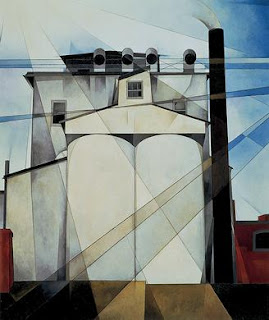
This semester, I'm teaching a 300-level seminar on 1930s America. In the last few years, I've been doing a lot of 1930s architectural historiography and I have realized the pivotal role this decade played in American culture. I've also began to appreciate what a tremendous impact Pennsylvania architects, artists, and intellectuals have made on the 30s. The seminar has seven students, most of whom I have taught before. They are all super smart and I look forward to work with them. I feel committed to the organic idea of seminars, where readings and research can change according to the direction that the conversation takes. I also feel committed to primary research on the physical fabric of Lancaster (like the Eshelman & Sons grain elevators that Demuth painted in "My Egypt," left). Although I am sure lots of things will change in action, the basic seminar structure is as follows:

1930s: BUILDING AMERICAN MODERNITY

Franklin & Marshall College, ART 375, Spring 2011, Professor Kostis Kourelis

COURSE DESCRIPTION

Although America was a pioneer in modernization, it was not until the late 1920s and 1930s that the country forged a unique American Modernism. Despite the hardships of the Great Depression, the Thirties produced the first golden age of American design from soaring skyscrapers and streamlined industrial products to Hollywood’s opulent fantasies and the New Deal’s sober public works. The Thirties were tortured by contradictions and competing visions of the future leading to a complicated decade of “grotesque” cultural expressions. Radicals and traditionalists, communists and capitalists, regionalists and internationalists confronted each other in the public sphere of architecture and urbanism and collectively developed the basics of American design. We will track the turbulent debates and the spectacular projects that emerged between the Great Crash and Pearl Harbor with a slight bias towards Pennsylvania’s contribution in the works of Paul Cret, George Howe, Charles Klauder, Frank Lloyd Wright, Louis Kahn, Wharton Esherick, George Nakashima, Charles Demuth, Charles Sheeler and Horace Pippin.

OBJECTIVES
I. To introduce students the history of architecture and design during the American 1930s. This will be accomplished through readings and lectures and will be tested with two quizzes.
II. To cultivate a critical way of seeing and feeling. This will be practices in the classroom through attentive analysis, reflective writing, and the introduction multiple media like literature, music and film.
III. To train students how to do original research in a workshop setting. This task will be accomplished through one small biographical presentation and through a more serious group project focusing on the arts and architecture of F&M and Lancaster.
IV. The class was conceived in the spirit of collaboration. Judging on the personal interests of the students, this syllabus is subject to change. As the semester progresses, we will concentrate on the ideas that organically develop through our conversation and will pursue them freely.

ORGANIZATION

The seminar is divided into three major units. In Part I, we will focus on the development of the American avant-garde in order to understand the wider experimental setting of the 1930s. We hope to comprehend the introduction of new cultural tropes and their assimilation in the American scene. Part I will be accompanied by two fieldtrips and a quiz.

Part II will focus on the three most important architects, who contributed to the creation of Modernism, Le Corbusier, Mies, and Wright. We will also turn our attention to a distinctly American version of Modernism (or according to some scholars, Traditionalism), Art Deco. Part II will be competed by a quiz.

In Part III, we turn our attention to the architects and artists who shaped the intellectual climate of Pennsylvania. Each student will be assigned one important personage and will complete a book review of their artistic contributions. Specific readings will be assigned by instructor. At this point, we will begin synthesizing the questions raised in Parts I & II and will inquire on their relevance to Pennsylvania. We will also read a primary document from 1932, the catalog of “International Style,” an exhibition at the Museum of Modern Art that ushered modernism into America. The student research reports will be graded on both coherence and thoroughness.

Finally, in Part IV, the entire class will begin a group project (professor Kourelis included). We will turn the city of Lancaster and Franklin & Marshall College into a temporary laboratory. Using resources at Special Collections, we will collectively tackle two major 1930s buildings on campus, Shadek-Fackenthal Library and Keiper Hall. They were both designed by Philadelphia architect William Lee, who made his name through spectacular movie theaters. Louis Kahn worked in his office. Each student will develop one particular angle of research that he/she will present during the last week of class. The final presentation will form the core of a final paper that will be turned in at the beginning of finals.

PART I: AVANT GARDES

Week 1
Jan 24 Marcel Duchamp [Corn, 43-89]
Jan 26 Joseph Stella [Corn, 135-190]
Jan 30 TRIP TO DC: National Portrait Gallery

Week 2
Jan 31 Charles Demuth [Corn, 193-237]
Feb 2 Historical Overture [Brendon, 3-78]
Feb 5 TRIP TO NYC: Whitney Museum, Chrysler Building, RCA Building

Week 3
Feb 7 Georgia O’Keefe [Corn, 239-291]
Feb 9 Charles Sheeler [Corn, 293-337]

PART II: MASTER BUILDERS

Week 4
Feb 14 Le Corbusier [Blake, 3-64]
Feb 16 Le Corbusier [Blake, 65-111]

Week 5
Feb 21 Mies van der Rohe [Blake, 167-215]
Feb 23 Mies van der Rohe [Blake, 216-254]

Week 6
Feb 28 Frank Lloyd Wright [Blake, 287-341]
Mar 2 Frank Lloyd Wright [Blake, 342-402]
Week 7
Mar 7 Art Deco [Brendon, 79-101]
Mar 9 Preservation & Traditionalism [Brendon, 257-280]
Quiz Part II

Spring Break

PART III: PENNSYLVANIA MODERN

Week 8
Mar 21 Paul Cret [Hitchcock , 33-49]
Mar 23 Charles Klauder [Hitchcock , 50-68]]

Week 9
Mar 28 George Howe [Hitchcock , 69-80]
Mar 30 Louis Kahn [Hitchcock , 81-100]

Week 10
Apr 4 Wharton Esherick
Apr 6 The World’s Fair [Cogdell]

PART IV: 1930s LANCASTER

Week 11
Apr 11 Lancaster
Apr 13 Franklin & Marshall College [Griffith]

Week 12
Apr 18 Archives
Apr 20 Workshop

Week 13
Apr 25 Final Reports
Apr 27 Final Reports

TEXTBOOKS

Blake, Peter. 1996. Master Builders: Le Corbusier, Mies van der Rohe, and Frank Lloyd Wright, New York.

Brendon, Piers. 2000. Dark Valley: A Panorama of the 1930s, London.

Cogdell, Christina. 2003. “Products or Bodies? Streamline Design and Eugenics as Applied Biology,” Design Issues, 19:1 (Winter), pp. 36-53

Corn, Wanda. 2001. The Great American Thing: Modern Art and National Identity, Berkeley.

Griffith, Sally F. 2010. Liberalizing the Mind: Two Centuries of Liberal Education at Franklin & Marshall College, University Park. PDF

Russel-Hitchcock, Henry and Philip Johnson. 1932. The International Style, New York.

Williams, William Carlos. 1991. The Collected Poems of William Carlos Williams, Vol. 1: 1909-1939, New York.

Blog Archive

Kostis Kourelis

Philadelphia, PA, United States