
Location: 40°03'09.56"N, 76°18'43.43"W
Collection: May 1, 2012


 Last weekend, I was in Detroit for the annual meeting of the Society of Architectural Historians, organizing the panel "From Idea to Building: Ancient and Medieval Architectural Process." Another priority in my Detroit visit was to follow up some ideas on the Punk Archaeology project. I wanted to investigate the topographies of memory related to Fred "Sonic" Smith, founder of MC5, godfather of punk and late husband of Patti Smith. Visiting sites of memory is appropriate to Smith and her recent exhibit Camera Solo at the Wadsworth Athenaeum (and soon moving to Detroit). I have already blogged about Smith, Whitman and archaeology here.


 In 1908, Henry C. Mercer wrote an essay “Where Concrete Stands for Concrete,” in Cement Age 6 (1908) pp. 9-20. Published in an engineering journal, the essay has been forgotten by scholarship. I would argue that it must be included in the anthologies of modern architectural theory. The essay tackles the perennial conflict between modern material (concrete) and medieval crafts (ceramic tiles). Rather than covering up the concrete with plaster or paneling, Mercer argues that the concrete should remain exposed. To hide concrete’s imperfections behind a false layer of false perfection was not only dishonest, but a lost aesthetic opportunity. By theorizing the aesthetic qualities of concrete, Mercer becomes a forefather of Brutalism, which blossomed half a century later. Rather than hiding the concrete, Mercer thought that it could be elevated into a nobler material if decorated by the similarly earthy medium of ceramic tiles. He recommended covering no more than 10% of the surface area with colored tiles. The essay is illustrated with an application of this strategy in a Philadelphia club house. Mercer’s idea was soon fulfilled in his Fonthill construction.
 In addition to its pioneering significance on the theories of form and function, Mercer emerges as an interesting spokesman for a Byzantinism radically different from the Byzantium that figures in Louis Comfort Tiffany work. This other and more famous figure of the American Arts-and-Crafts also experimented with the visual qualities of Byzantine surface and the optical effects of glass and mosaic. For Tiffany, however, Byzantium was not a 10% application, but a complete cover-up of every visible surface. If Mercer's Byzantium is about conflict and dialectic, Tiffany's Byzantium is about surface and illusion. If Mercer's Byzantium is haptic and embodied, Tiffany's Byzantium is optic and disembodied.
 Henry C. Mercer is a central figure in the development of the American Arts & Crafts movement. He is doubly important as an archaeologist. He excavated native American sites, directed the University of Pennsylvania Museum of Archaeology, and began a field of vernacular tool studies. His life highlights the intimate connection between the epistemologies of archaeology and the arts as they were defined by Charles Norton, whose arts curriculum informed Mercer's rebellion.
 The rediscovery of Georg von Peschke has been magical. The Philadelphia Inquirer has called my show "excellent and enterprising." I couldn't be prouder. Now that we've put Peschke back on the map, I hope that other scholars will join in the profound questions that Peschke raises: transnational bohemia. the archaeology of Greek life, Byzantium and the vernacular, the interface of positivism with fantasy, etc. Artemis Leontis (University of Michigan) started the discussion last week in her lecture, "Greek Dress and the Embodied Archaeology of Eva Palmer Sikelianos."
 The Peschke show has forced me to revisit some canonical images of Greek landscapes and I have revisited one of the most important photographic publications on Greece, the Wasmuth volume on Greece, Hans Holdt and Hugo von Hoffmanstahl, Griechenland: Baukunst, Landschaft, Volksleben (Berlin, 1923). This volume constitutes a landmark in the history of visualizing Greece within the German tradition. The subtitle tickled me a bit because it corresponds closely to the thematic divisions that I have given to Peschke's ouevre in the show: Buildings, Landscapes, Folk Life.
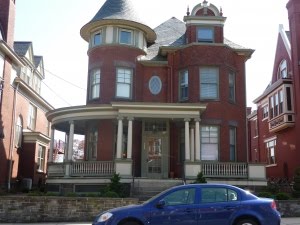
 A public blog has been an integral part of how I teach my history of architecture at Lancaster. Rather than submitting material on paper, students post a weekly progress report on their research. I have found this to be successful in two ways. The public nature of the blog means that the local community can take part in the conversation. On numerous occasions, experts from the community have engaged with the students. In one case, we discovered a previously unknown architect and private archival collections. The second reason why a blog works better than a paper is that students are able to share their primary sources and their insights. Knowing that the whole world is watching also raises the bar of accountability.
 The festivities began with my lecture, "Georg von Peschke: The Archaeology of Greek Life."
 With Tracey Cullen, editor of Hesperia. In 2007, Tracey insisted that I track down the Peschke estate in order get copyright permission to use a Peschke reproduction. This lead to my discovery of the Peschke family in California and the beginning of a wonderful relationship.
 With Brian Wallace, the new Curator and Academic Liaison for Art and Artifact Collections at Bryn Mawr College. Brian began his new job in January and inherited the project in process. He shepherded its completion victoriously. I'm proud that this was his first show at Bryn Mawr.
 Pamela Sinkler-Todd (daughter of Homer Thompson and Dorothy Burr Thompson) with Marianna Monaco (daughter of Georg von Peshcke).
 Of course, none of this would have been possible without the support of this lady, Celina Gray
 The genius of Steve Tucker, exhibitions designer. Steve has done extraordinary projects at Bryn Mawr, the Rosenbach Library, the Philadelphia Library Company, etc.
 COLORS OF GREECE:
 My colleague Dorothy Merritts sent me a fascinating response to last posting The Dog at the Mill. I quote here: "I checked your blog and am intrigued. In fact, I did a search on dog and mill, carving, and the name of the artist (Courtenay) who carved the mantel at the Powell house, and you will be amazed at what I found: http://www.chipstone.org/publications/1996AF/Randall/1996RandallIndex.html. This particular website indicates that there are links among Franklin's Poor Richard's Almanac, Aesop's fable "The Dog and the Meat", mills, millers, iron forges, Stiegel, and more. The iron forges, incidentally, also built dams to use water power to run bellows, turn various things, etc. All iron forges have dams and led to the industrialization of waterways, even though the use of water power had a different outcome than, say, a flour or fulling mill. Regardless though, a stream was dammed and a pond formed that could trap sediment, burying original wetlands, and later leading to deeply incised powerful streams where meadows once were the habitat of bog turtles and sedges." Thank you Dorothy
 Dorothy Merritts and Robert Walter, my colleagues at the Department of Earth and Environment, have been doing some amazing research on the aggressive manipulation of the natural environment in 18th and 19th century Pennsylvania. They have been studying the proliferation of mills through the country-side and the radical alteration of streams.
 Restoring old plaster involves those magic plaster washers that only Kilian's at Chestnut Hill carries. Loaded with plaster washers and heavy bags of plaster dust, I decided to take the long way home, and drive the entire length of Germantown Avenue, one of my favorite American streets (where you can see the discordant clash between the 18th and 21st centuries).
 Philadelphia Museum of Art
 On my way back from laying out the Peschke show at Bryn Mawr College, I stopped at the Old Cathedral Cemetery, next to Our Mother of Sorrows church on 48th & Lancaster Ave. There's a monument there that matches a type I referred to as "Steeple Cross Grave Monuments" (Dec. 14, 2011). The tomb belongs to Owen Brady (+1891) and his wife Mary (+1887). On the right side of the monument, two additional family members are marked, John I. Brady (+1907) and his wife Mary (+1906).

 My class on Medieval Art and Architecture congregated at the Phillips Museum yesterday afternoon for a workshop on icon painting by Dorothy Thayne, F&M artist in residence. The drawing, or "writing" of icons involves a fascinating process of "layering veils." Using her own work, Dorry demonstrated the spiritual process of making icons.
 Teaching medieval art, one encounters the topic of devotional practices that modern students do not always comprehend. Seeing an icon painter perform the process best illustrates the technical dimensions of pigment layering, as well as, the symbology. It was a priceless experience.
 The workshop took place in the Dana Gallery of the Phillips Museum, where we are currently having our faculty show. Dorry's two icons are part of the exhibition.
 The demonstration brought devotional art to life. We learned how the wood is like the tomb, and the fabric on top of the wood is the shroud. We learned about the different spiritual lights that are layered on the icon. We learned about light and shadow, pigments and their hierarchy of coarseness. We learned about tempering the material. We also learned about typology (the Theotokos Eleousa, etc.) and the reasons why an icon-painter chooses the types that she works with.


